
One of the most amazing places on the Earth’s is where two massive tectonic plates are moving apart. Almost 99% of thee areas take place under the oceans, which just a few exceptions above sea level, such as the African Rift Valley and Iceland.

This is a small section of a divergent plate boundary that is exposed above sea level in Iceland. The bridge supposedly lets you walk from one continent to the other. While a great tourist place, it is most probably not the true plate boundary, but it is a wonderful place to learn about the concept of divergent plate boundaries.
Divergent Plate Boundaries and Mid Ocean Ridges
When plates move apart (or diverge) molten material moves up and adds to the crustal plate on either side. Because the nature of that molten material is basaltic, it is in these zones that new oceanic crust is being formed. And what is more, the ages of the basalt material added to each side are the same. So when you move away from the plate boundary, the rocks get progressively older on each side of the boundary.
Also, any small needle-like magnetic minerals will line up with the Earth’s current magnetic field within the molten rock and then become frozen in that direction when the rock cools. This pattern is repeated on either side of the boundary. When the Earth’s magnetic field changes (see more here on Polar Reversals), so do those mineral needles in new molten rock. Over millions of years, we get a striping of those changes which are reflected around the boundary.
The heat of the upwelling molten rock heats the surrounding crustal rocks (basalts) which makes them expand to form a prominent ocean ridge. These are the famous Mid Ocean Ridges or MORs. As these heated rocks move away from the heat source they contract to form the deep abyssal basaltic ocean floor.

This a map of the ocean floor in the middle of the North Atlantic Ocean. Here the plate boundary is drawn with a red line, and the hight of the MOR is shown to be bright blue at its tallest and then shrinking away to purple on the true abyssal plain.
Also, black dots represent the location of earthquakes. All these are very shallow in depth. This is to be expected, as the crustal rocks here are very thin, around 5-15 km thick, and so all earthquakes will be in that zone.
Another striking feature is horizontal fracture zones that run out from the MOR. These fracture zones are caused by the MOR not spreading evenly along its length and the curvature of the Earth. These fracture zones can sometimes offset the plate boundary, as seen in the middle of this map.
This phenomenon means that as the plates diverge, there are small segments of the boundary that are moving against in each other along transform faults. It is in these zones most of the earthquakes occur.
To get a high-resolution map of the Earth plate boundaries, visit this USGS page.
So in summary, the features we find at Divergent Plate Boundaries:
- Mid Ocean Ridges
- Creation of new basaltic oceanic crust on each side of the boundary.
- Rocks great older as you move away from the boundary on both sides.
- Rocks contain the same magnetic mineral patterns on either side of the boundary.
- Shallow earthquakes.
More about Plate Tectonics…

Writing Prompts

Microfossils
Shale – and how we use it.

Sandstone – quartz, arkose and lithic

Apparent Polar Wandering & Plate Tectonics
Seismic Shadow

Seeing Inside the Earth

Tectonic Plates – Lithosphere, Moho, Asthenosphere
Plate Tectonics Battleships
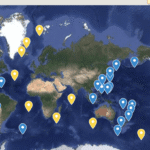
Earth’s Plate Tectonic Features – ld
World Earthquakes by Depth – LD

Divergent Dilemma
What is the history of the theory of Plate Tectonics?

What are the mechanisms that drive Plate Tectonics?

Seeing inside the Earth

Earth’s Interior Layers

Earth’s layers explained

Plate Tectonics Google Map
Benioff Zones – earthquake evidence for subduction
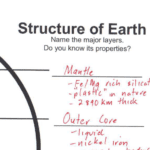
Structure of Earth

Volcano shapes – shield, composite/stratiform, caldera – and chemistry
Transform fault plate boundaries – what are their features?
Convergent plate boundaries – subduction, collision and Island arcs – what are their features?
Divergent plate boundaries – what are their features?
The Evidence for Plate Tectonics
Earth’s Magnetic Reversals, Polar Wandering and Plate Tectonics

Earthquakes – what you need to know!
Introduction to Plate Tectonics

Lava in Lihue – Role play activity
Rocks of Ages

Evidence for Plate Tectonics

Boundaries – how the plates interact

Plates – understanding the tectonic jigsaw pieces.

The Earth’s Crust – a simple way to view it.